
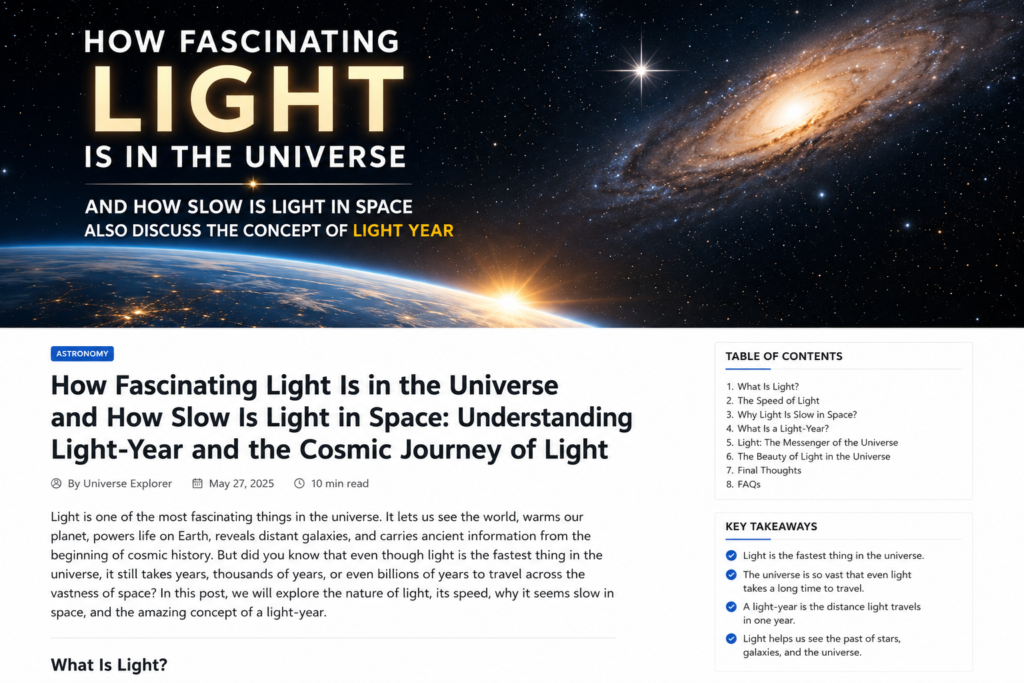
Light is one of the most fascinating things in the universe.
It lets us see the world, warms our planet, powers life on Earth, reveals distant galaxies, and carries ancient information from the beginning of cosmic history. Every sunrise, every star in the night sky, every photograph of a galaxy, and every color we see exists because of light.
But here is the mind-bending part:
Light is the fastest known thing in the universe — yet across space, even light feels incredibly slow.
That sounds impossible at first. After all, light travels at nearly 299,792 kilometers per second. In one second, light can travel around Earth about seven and a half times. That speed is almost beyond human imagination.
Still, the universe is so enormous that light takes minutes, years, thousands of years, or even billions of years to travel from one place to another.
This is where the true mystery begins.
What Is Light?
In simple terms, light is a form of energy that travels as electromagnetic radiation. It moves in waves and also behaves like tiny packets of energy called photons.
Light is not only the visible brightness we see with our eyes. Visible light is just a small part of a much larger electromagnetic spectrum.
This spectrum includes:
- Radio waves
- Microwaves
- Infrared light
- Visible light
- Ultraviolet light
- X-rays
- Gamma rays
Our eyes can only detect a narrow band of this spectrum. The universe, however, is glowing in many forms of invisible light all the time.
That means when scientists study space, they do not only look through normal telescopes. They use radio telescopes, infrared telescopes, X-ray observatories, and many other instruments to understand what the universe is saying through light.
In a way, light is the language of the universe.
Why Light Is So Important in Space
Light is not just brightness. It is information.
When light travels from a star, galaxy, planet, or nebula, it carries clues about that object. By studying light, scientists can understand what distant objects are made of, how hot they are, how fast they are moving, and even how old they might be.
For example, by analyzing starlight, astronomers can learn:
- The chemical elements inside stars
- The temperature of stars
- The movement of galaxies
- The presence of planets around distant stars
- The expansion of the universe
- The age of ancient cosmic objects
Without light, astronomy would be almost blind.
Every star you see in the night sky is sending light across space. Some of that light started its journey years, centuries, or even thousands of years before it reached your eyes.
So when you look up at the night sky, you are not seeing the universe exactly as it is right now.
You are seeing the past.
The Speed of Light: The Fastest Speed Limit in the Universe
The speed of light in a vacuum is about:
299,792 kilometers per second
Or roughly:
300,000 kilometers per second
That is unimaginably fast by human standards.
To understand how fast this is, think about it this way:
Light from the Moon reaches Earth in about 1.3 seconds.
Light from the Sun reaches Earth in about 8 minutes and 20 seconds.
That means when you look at the Sun, you are not seeing the Sun as it is at that exact moment. You are seeing the Sun as it was more than eight minutes ago.
If the Sun suddenly disappeared, we would not know instantly. For about eight minutes, Earth would still receive sunlight.
That is how space works.
Nothing we see in space is truly “live.” Everything is delayed by the travel time of light.
If Light Is So Fast, Why Do We Say It Is Slow in Space?
This is one of the most beautiful and humbling ideas in astronomy.
Light is not slow because its speed is small. Light is slow because the universe is too large.
Space is so vast that even the fastest thing in existence takes time to cross it.
Imagine driving a car at 100 km/h. That feels fast on a road. Now imagine trying to drive that car to another planet, another star, or another galaxy. Suddenly, 100 km/h feels useless.
The same thing happens with light.
Light is extremely fast near Earth. But when distances become cosmic, even light struggles to make the journey quickly.
For example:
The Sun is close to us by cosmic standards, but sunlight still takes over 8 minutes to reach Earth.
The nearest star system to the Sun, Alpha Centauri, is about 4.37 light-years away. That means its light takes more than four years to reach us.
Our Milky Way galaxy is around 100,000 light-years wide. Light would take about 100,000 years to travel from one side of our galaxy to the other.
The Andromeda Galaxy is about 2.5 million light-years away. When we see Andromeda in the night sky, we are seeing it as it looked about 2.5 million years ago.
This is why light feels slow in space.
It is not because light is weak. It is because the universe is unimaginably huge.
What Is a Light-Year?
A light-year sounds like a measure of time, but it is actually a measure of distance.
A light-year is the distance light travels in one year.
Since light travels at about 300,000 kilometers per second, it covers a massive distance in one year.
One light-year is approximately:
9.46 trillion kilometers
That is:
9,460,000,000,000 kilometers
This number is so large that using normal kilometers becomes difficult. That is why astronomers use light-years. It makes cosmic distances easier to discuss.
For example, instead of saying a star is 41 trillion kilometers away, we can say it is about 4.3 light-years away.
That sounds simpler, but it is still an enormous distance.
Why the Concept of a Light-Year Is So Powerful
The concept of a light-year helps us understand both distance and time.
When we say a star is 100 light-years away, it means two things:
First, the star is extremely far away.
Second, the light we see from that star today started traveling 100 years ago.
So if you look at a star that is 100 light-years away, you are seeing light that left that star a century ago.
If a galaxy is 1 billion light-years away, we are seeing it as it looked 1 billion years ago.
This means telescopes are not just tools for seeing far away.
They are also time machines.
The deeper we look into space, the further we look into the past.
The Universe We See Is Actually the Universe’s History
Because light takes time to travel, the night sky is like a cosmic history book.
Some stars we see may have changed. Some may have exploded. Some galaxies may look different now. But their old light is still reaching us.
This gives us a powerful way to study the past.
When astronomers observe distant galaxies billions of light-years away, they are seeing those galaxies when the universe was much younger.
This is how scientists study the early universe.
They do not need to physically travel back in time. They simply look far enough into space.
The farther away an object is, the older the light reaching us.
This is one of the most fascinating truths about light:
Light preserves the past.
Light Makes the Universe Visible
Without light, the universe would be dark, silent, and hidden.
We would not see stars. We would not know galaxies exist. We would not understand the structure of the cosmos.
Light reveals:
- Stars being born inside nebulae
- Planets orbiting distant suns
- Black holes pulling in matter
- Galaxies colliding
- Supernova explosions
- Cosmic dust clouds
- The afterglow of the early universe
Even black holes, which do not allow light to escape from inside their event horizon, can be studied because of the light emitted by hot material around them.
In other words, light helps us study even the darkest objects in space.
The Strange Relationship Between Light and Time
Light is deeply connected to time.
According to modern physics, the speed of light is not just a speed. It is a fundamental limit of the universe.
Nothing with mass can travel faster than light in a vacuum.
This means light defines the cosmic speed limit.
It also means that when we observe distant objects, we are always dealing with delayed information.
For example:
If a star is 500 light-years away, any change happening there right now will not be visible to us for 500 years.
If intelligent life existed on a planet 1,000 light-years away and looked at Earth through an extremely powerful telescope, they would not see our modern world. They would see Earth as it was 1,000 years ago.
This changes how we think about reality.
The universe does not show itself instantly. It reveals itself slowly, through light.
Why Space Is Bigger Than Human Imagination
Human brains are good at understanding everyday distances.
We understand meters, kilometers, cities, countries, and maybe the distance between Earth and the Moon.
But cosmic distances break our normal sense of scale.
The Moon is about 384,400 kilometers away.
The Sun is about 150 million kilometers away.
The nearest star system is over 40 trillion kilometers away.
The Milky Way is about 100,000 light-years across.
The observable universe is about 93 billion light-years wide.
At this scale, even light seems slow.
This is why space exploration is so difficult. Even if we could travel at the speed of light, reaching nearby stars would take years. Reaching other galaxies would take millions of years.
The universe is not just big.
It is almost beyond comprehension.
Light and the Beauty of the Night Sky
Every night sky is a mixture of beauty and ancient history.
When you see a star, you are seeing a tiny beam of light that has traveled across space for years. That light crossed unimaginable emptiness just to reach your eyes.
Some of the stars you see are close. Some are far. Some may already be gone. But their light continues traveling.
This makes the night sky emotionally powerful.
It reminds us that the universe is not only scientific. It is also poetic.
Every star is a message.
Every ray of light is a traveler.
Every telescope image is a memory from deep time.
Why Light Is Fascinating for Science and Philosophy
Light is fascinating because it connects science, time, distance, reality, and existence.
Scientifically, light helps us understand the universe.
Philosophically, light reminds us that what we see is not always the present.
When we look at space, we are looking at delayed reality.
This raises deep questions:
Are we ever seeing the universe as it truly is right now?
How much of reality is hidden because its light has not reached us yet?
Could there be objects so far away that their light will never reach Earth?
These questions make light one of the most mysterious and meaningful parts of the universe.
Is Light Really Slow?
In normal life, light is incredibly fast.
On Earth, light feels instant. When you switch on a bulb, the room lights up immediately. When you look at your phone, the screen appears instantly. When sunlight enters your window, it feels immediate.
But space changes everything.
In space, distance is the real challenge.
Light is fast, but the universe is faster in scale.
So the better question is not, “Is light slow?”
The better question is:
How enormous must the universe be if even light takes billions of years to cross it?
That is the real wonder.
Simple Examples to Understand Light Travel Time
Here are some easy examples:
Light from the Moon
Light takes about 1.3 seconds to travel from the Moon to Earth.
Light from the Sun
Sunlight takes about 8 minutes and 20 seconds to reach Earth.
Light from Alpha Centauri
Light from our nearest neighboring star system takes about 4.37 years to reach us.
Light across the Milky Way
Light takes around 100,000 years to cross our galaxy.
Light from Andromeda
Light from the Andromeda Galaxy takes about 2.5 million years to reach Earth.
These examples show why light-years are necessary. Kilometers become too small for the universe.
Final Thoughts: Light Is the Universe’s Greatest Storyteller
Light is more than brightness.
It is energy, information, history, and mystery.
It helps us see the present on Earth and the ancient past in space. It tells us what stars are made of, how galaxies move, and how the universe has evolved.
Light is the fastest known thing in existence, yet the universe is so vast that even light seems slow.
That single idea is enough to make us humble.
When you look at the night sky, remember this:
You are not just seeing stars.
You are seeing ancient light.
You are seeing time.
You are seeing the universe telling its story, one photon at a time.
FAQs About Light in the Universe
What is the speed of light?
The speed of light in a vacuum is about 299,792 kilometers per second, often rounded to 300,000 kilometers per second.
2. What is a light-year
A light-year is the distance light travels in one year. One light-year is about 9.46 trillion kilometers.
3. Is a light-year a measure of time?
No. A light-year sounds like time, but it is actually a measure of distance.
4. Why does light feel slow in space?
Light feels slow in space because the universe is extremely large. Even at 300,000 kilometers per second, light takes years, millions of years, or billions of years to travel cosmic distances.
5. Are we seeing stars in the past?
Yes. Since light takes time to travel, every star we see appears as it was when its light began traveling toward Earth.
6. Can anything travel faster than light?
According to current physics, nothing with mass can travel faster than light in a vacuum.
7. Why do astronomers use light-years?
Astronomers use light-years because distances in space are too large to express conveniently in kilometers or miles.