

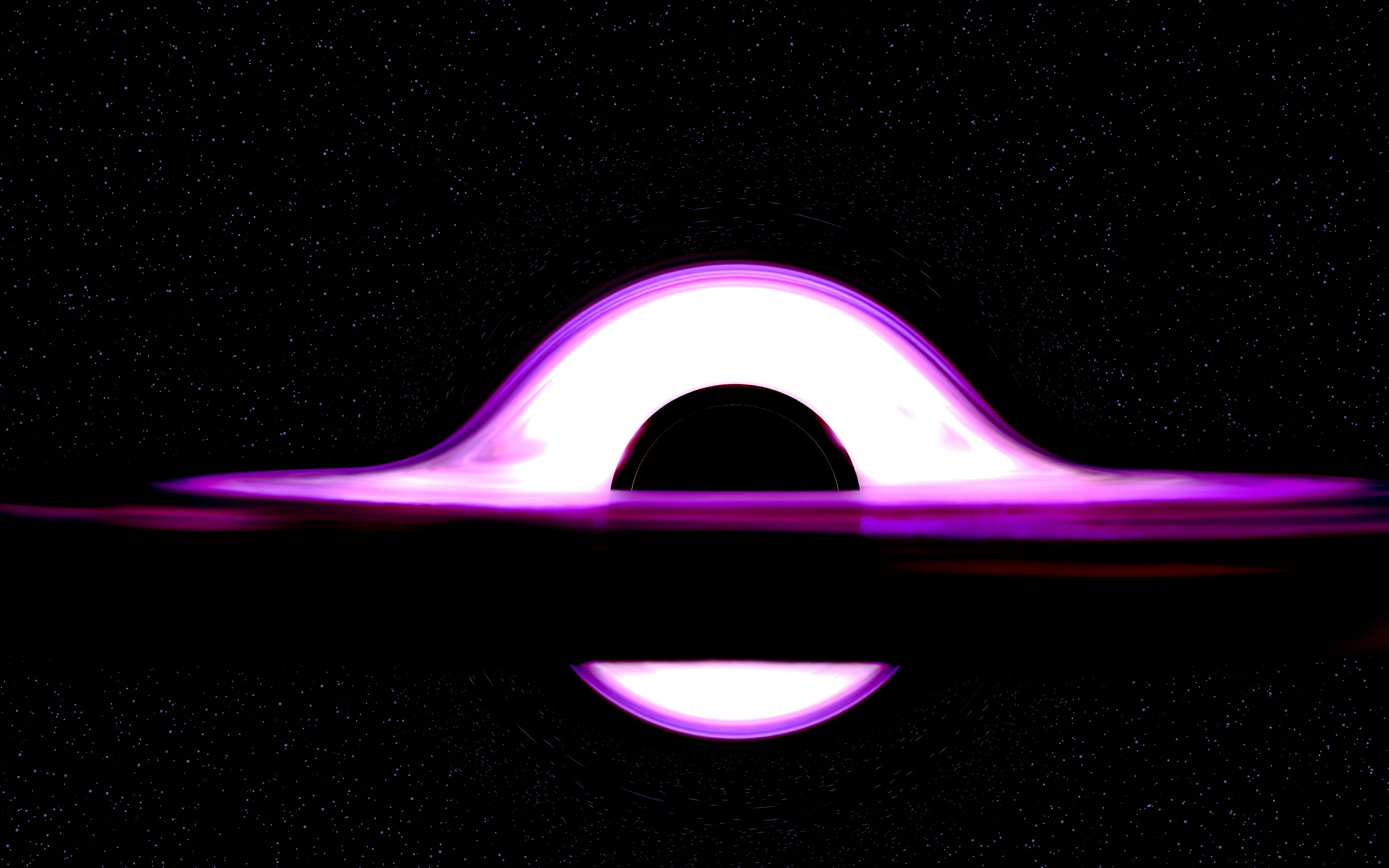
What is a Black Hole?
A black hole is a region in space where the gravitational pull is so intense that nothing, not even light, can escape from it. The formation of a black hole typically occurs when a massive star exhausts its nuclear fuel, leading to a collapse under its own gravity. This collapse results in a dense core that significantly warps the fabric of spacetime, creating a boundary known as the event horizon, beyond which no information can return.
Black holes are categorized into different types based on their mass and formation process. The most commonly recognized type is the stellar black hole, which forms from the remnants of massive stars after a supernova explosion. These black holes usually have a mass ranging from about three to several tens of solar masses.
On a larger scale, supermassive black holes exist at the centers of galaxies and can possess masses equivalent to millions or even billions of suns. Their formation is thought to involve the merging of smaller black holes and the accretion of surrounding matter over billions of years. Intermediate black holes, on the other hand, are less understood but are believed to lie in the mass range between stellar and supermassive black holes. They may arise from the merging of numerous stars in dense star clusters.
Key terminology related to black hole physics includes the singularity, which refers to the point at the center of a black hole where density becomes infinite, and current laws of physics cease to function predictably. The concept of gravity is crucial in the formation and existence of black holes, as it is the fundamental force that drives their creation and defines their characteristics.
The Fascination with Black Holes
Black holes have captivated both scientists and the general public for decades, primarily due to their enigmatic nature and the extreme conditions surrounding them. These cosmic entities possess gravitational pull so intense that not even light can escape, which makes them invisible to the naked eye. This clandestine existence raises questions about the fundamental laws of physics, as they challenge our understanding of space, time, and gravity. The study of black hole physics opens avenues for researchers to explore concepts such as event horizons, singularity, and the behavior of matter under extreme pressure.
Furthermore, the implications of black holes extend beyond theoretical science; they touch upon the very fabric of our universe. Investigating these fascinating phenomena can offer insights into the origins of galaxies and the fate of the universe itself. Such topics ignite curiosity and wonder among astronomers and physicists, prompting them to delve deeper into understanding these celestial mysteries. The allure of black holes is also prevalent in popular culture, as they lend themselves well to fantastical interpretations in movies, television shows, and literature, often depicted as gateways to other dimensions or time travel.
The portrayal of black holes has sparked public imagination, making them a topic of discussion among enthusiasts and casual viewers alike. Their dramatic representation enhances the appeal, while also prompting necessary discussions about real-world science. Ultimately, black holes serve as a bridge between advanced scientific theories and broader societal questions about existence and the universe’s nature, making them a captivating subject for ongoing exploration and debate.
Our Black Hole: Sagittarius A
At the heart of our galaxy, the Milky Way, lies a supermassive black hole known as Sagittarius A* (pronounced “Sagittarius A star”). It is located approximately 26,000 light-years from Earth, in the direction of the constellation Sagittarius. This fascinating cosmic phenomenon has garnered significant interest from astronomers and astrophysicists alike due to its size and the role it plays in the dynamics of our galaxy.
Sagittarius A* is estimated to have a mass equivalent to about four million times that of our Sun, which makes it one of the most compelling subjects of black hole physics. Its gravitational pull influences the orbits of nearby stars, allowing scientists to infer its mass and properties through their motion. This, in turn, provides invaluable information about the behavior of black holes and their impact on surrounding stellar environments.
The study of Sagittarius A* has evolved over several decades, with its existence initially suggested in the early 1970s. Observational evidence continued to mount over the years, primarily through radio wave emissions detected by telescopes in various parts of the world. The most significant breakthrough came in 2019 when astronomers unveiled the first-ever image of a black hole’s event horizon, which highlighted the shadows cast in the vicinity of Sagittarius A*. This landmark achievement has offered new insights not only into black holes but also into the fundamental laws of physics governing the universe.
Understanding the nature of Sagittarius A* is crucial, as it provides a window into the formation and evolution of galaxies. Supermassive black holes like Sagittarius A* are believed to have emerged alongside their host galaxies, indicating a profound link between the formation of black holes and galaxy structure. As researchers delve deeper into the mysteries of this intriguing black hole, they continue to broaden our understanding of black hole physics and the larger universe.
Black Hole Physics: Theoretical Foundations
The study of black holes necessitates a robust understanding of the fundamental principles of physics, notably through the lenses of general relativity and quantum mechanics. General relativity, proposed by Albert Einstein, revolutionized the perception of gravity as a geometric property of spacetime. In this framework, black holes emerge as regions where gravitational forces are so intense that nothing, not even light, can escape their grasp. This phenomenon results in intriguing implications regarding the nature of spacetime and the behavior of matter near these enigmatic objects.
Key to understanding black hole physics are the laws of thermodynamics, particularly when applied to black holes. The first law states that the increase in mass-energy is proportional to the change in entropy, while the second law indicates that entropy can never decrease. Notably, being able to associate entropy with black holes leads to a radical implication: they are not merely celestial vacuums, but instead have a thermodynamic nature that evokes deeper questions about information and entropy in the universe.
Hawking radiation, a concept proposed by physicist Stephen Hawking, blends principles from quantum mechanics with black hole physics, suggesting that black holes can emit radiation due to quantum effects near their event horizons. As a result, black holes can ultimately lose mass and even evaporate over astronomical time scales. This discovery spurred significant discussion on the information paradox, which questions what happens to information that falls into a black hole, challenging traditional perspectives on information conservation in physics. Understanding these principles is essential, as they form the backbone of more advanced discussions surrounding black holes and their fascinating characteristics.
Recent Discoveries in Black Hole Research
The field of black hole physics has progressed significantly in recent years, leading to a greater understanding of these fascinating celestial objects. One of the most groundbreaking developments was achieved by the Event Horizon Telescope (EHT), which successfully captured the first image of a black hole in 2019. This historic moment provided direct visual evidence of the presence of black holes in the universe, particularly the supermassive black hole at the center of the galaxy M87. The image revealed a shadow surrounded by a halo of hot gas, marking a pivotal achievement in astrophysics.
Moreover, the detection of gravitational waves, ripples in spacetime caused by the collision of black holes, has opened new avenues in our comprehension of their existence and interactions. The first detection of these waves was made by the Laser Interferometer Gravitational-Wave Observatory (LIGO) in 2015, confirming long-standing predictions by Albert Einstein’s General Theory of Relativity. Since then, LIGO, along with its European counterpart, Virgo, has observed multiple events of black hole mergers, enhancing our understanding of their formation and population in the universe.
These discoveries not only validate theoretical predictions but also pose new questions about the role of black holes in galactic evolution and the fundamental mechanics of the universe. For instance, researchers are actively investigating how black holes influence star formation and the dynamics of surrounding matter. This recent surge in black hole research fosters collaboration across various disciplines, pushing the boundaries of our knowledge and igniting a deeper fascination with the enigmatic nature of black holes.
Black Holes and Time Dilation
One of the most intriguing aspects of black hole physics is the concept of time dilation, a phenomenon predicted by Albert Einstein’s theory of general relativity. As an observer approaches the event horizon of a black hole, the gravitational pull experienced becomes extraordinarily strong, resulting in significant alterations to the flow of time. This effect is rooted in the fundamental idea that gravity can warp spacetime, leading to astonishing implications for our understanding of time itself.
For an observer stationed far from the black hole, they would note that time for anything falling towards the event horizon appears to slow down substantially. As the object nears this boundary, time effectively stretches, making it seem as if the object is moving in slow motion. Conversely, for someone falling into the black hole, the passage of time feels normal, and they would perceive no changes in the rhythm of their own temporal experience. This fascinating disparity underscores how relative time can be, revealing the strange reality that events can be perceived differently depending on one’s proximity to massive gravitational forces.
These implications of time dilation extend beyond mere theoretical discussions and find relevance in potential scenarios concerning space travel. Imagine astronauts venturing close to a black hole’s event horizon, experiencing time at a dramatically different rate compared to those remaining on Earth. Such a journey could lead to extraordinary outcomes, where years pass for those traveling while centuries elapse back home. This peculiar reality poses profound questions about aging, travel distances, and the very nature of time as humanity delves deeper into the enigmatic realms of astrophysics.
In conclusion, the relationship between black holes and time dilation offers a remarkable glimpse into the complexities of reality governed by gravitational forces. Understanding these dynamics not only fascinates scientists and scholars but also encourages further exploration into the universe and its many mysteries.
The Future of Black Hole Research
The field of black hole research is poised for significant advancements in the coming years, driven by both technological innovations and new theoretical frameworks. One of the most anticipated instruments is the James Webb Space Telescope (JWST), set to broaden our understanding of black holes through its advanced observational capabilities. The JWST, with its ability to capture infrared spectra, will allow scientists to explore the environments surrounding black holes, offering insights into their formation and growth mechanisms, which remain largely enigmatic. This knowledge is vital as it will help to uncover how black holes influence galaxy evolution and cosmic structure.
In parallel, the development of next-generation gravitational wave observatories is on the horizon. Projects like the Laser Interferometer Space Antenna (LISA) aim to detect gravitational waves from merging black holes with unprecedented precision. Such findings will not only enhance our understanding of black hole physics but also provide a novel way to test general relativity in extreme conditions. Observing these waves can lead to the discovery of previously unseen black hole populations, thus enriching our comprehension of the universe’s dynamics.
Moreover, as computational power continues to evolve, simulations of black hole interactions will grow increasingly sophisticated, facilitating more accurate predictions and helping to address questions around the potential existence of primordial black holes and their role in dark matter. The ongoing study of these celestial phenomena holds broader implications for astrophysics, as each discovery regarding black holes could potentially unravel further mysteries related to the fabric of spacetime and the nature of gravity itself. As researchers set their sights on these upcoming projects, they remain committed to tackling fundamental questions about the universe, ensuring that the fascination with black holes will only deepen in the years to come.
The Role of Black Holes in the Universe
Black holes play a critical role in the structure and evolution of the universe, influencing galaxy formation and dynamics in fundamental ways. These enigmatic entities, formed from the remnants of massive stars, contribute to the gravitational forces that shape galaxies. As matter is drawn into a black hole, it begins to create jets and accretion disks, leading to the emission of powerful radiation. This process not only illuminates the presence of black holes but also facilitates energy transfer between different cosmic structures, aiding in star formation and the maintenance of galactic stability.
The relationship between black holes and dark matter is particularly intriguing. Dark matter, which constitutes a significant portion of the universe’s total mass, interacts with visible matter primarily through gravity. It is theorized that black holes may anchor clustering patterns of dark matter, thereby helping to explain the large-scale structures observed in the cosmos. Understanding the interplay between these two components is vital for a comprehensive picture of galaxy morphology and evolution.
Moreover, research into black hole physics provides insights into fundamental gravitational processes and the nature of spacetime itself. By studying how black holes manipulate their surroundings, scientists glean essential knowledge regarding the universe’s expansion and the distribution of dark energy, which exhibits a critical influence on cosmic dynamics.
As we continue to delve into the complexities of black holes, we uncover layers of understanding that link these powerful phenomena to broader cosmic principles. Their mysterious nature not only captivates researchers but drives an ever-growing body of inquiry that strives to illuminate the intricate tapestry of our universe.
Concluding Thoughts on Black Holes
Throughout this exploration of black holes, we have delved into the various aspects that make these astronomical entities so captivating. Black holes represent a profound area of study within the realm of astrophysics, blending intricate mathematics with observational science. Their formation, characterized by the gravitational collapse of massive stars, leads to the creation of regions in space where the gravitational pull is so intense that nothing, not even light, can escape.
This enigmatic nature is the very reason why black hole physics continues to intrigue scientists and amateurs alike. The curiosity surrounding these phenomena not only fuels scientific inquiry but also ignites the public’s imagination. From the Event Horizon Telescope’s first image of a black hole to recent gravitational wave detections from colliding black holes, each discovery enhances our understanding and highlights the dynamic behaviors of these cosmic titans.
Moreover, engaging with the philosophical dimensions of black holes prompts us to reflect on our comprehension of time, space, and the universe itself. Questions regarding the information paradox, the nature of singularities, and their ultimate fate push the boundaries of what we know and challenge established theories in physics. As we continue to study black holes, we are reminded of the vast unknowns that remain in our universe.
In conclusion, the fascination with black holes is driven by their inherent mysteries and the significant advancements in black hole physics. The continuous revelations about these fascinating entities not only deepen our understanding of the cosmos but also challenge our perceptions of reality. Therefore, pursuing knowledge about black holes may very well lead to some of the most groundbreaking discoveries in the years to come, encouraging us to cultivate an ongoing curiosity about the universe that surrounds us.